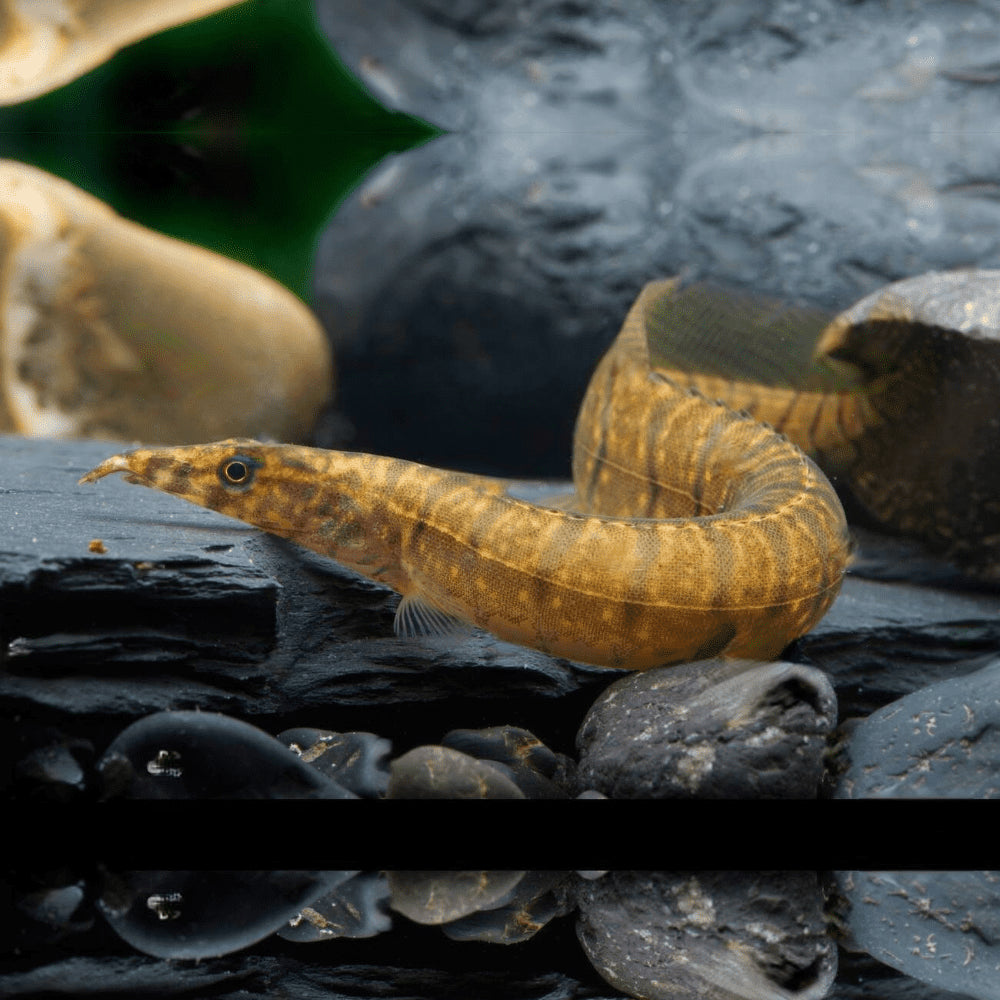

Spiny Eel
Spiny Eel
The spiny eel is quite easily one of the best oddball aquarium fish for smaller aquariums. This unique fish reaches around 15 cm and is actually not a true eel but more closely related to loaches. Spiny eels would make a great centrepiece fish for relatively small aquariums.
Spiny eels are not really that spiny, they may get this name because of the really pointed nose they have which is used to sift and burrow into the sand. These fish do have really interesting colouring with a range of brown and yellow shaded stripes running from head to tail. They also have an assortment of black spots which are found near the end of the eel.
Part of the enjoyment when keeping this fish is trying to find it in the aquarium since they spend a lot of time burrowed under the sand. Their reclusive but calculated behaviour offers hours of fun.
Breeding spiny eels in captivity has been documented in the past but it does seem to be a fluke occurrence as these fish often require specific environmental conditions when breeding. Females and males do look identical and it is usually best to keep them in a group if the intention is to breed them. Having a lot of dense vegetation in the tank helps as these fish seem to spawn in the plants. The wild origin of the spiny eel is widespread throughout South-East Asia.
Tank Recommendations for your Spiny Eel
Since the spiny eel only reaches around 15 cm as an adult they can be kept in smaller aquariums as long as the habitat is ideal. The minimum aquarium volume for this fish would be 70L, it is best to go for longer and wider tanks than taller ones. Spiny eels spend a lot of their time near the bottom of the tank and in the substrate. Though they can be kept in a bare bottom tank, it’s best to have a soft sandy substrate layer in the tank.
Rock caves and driftwood can be added for additional cover along with plants which really create a natural habitat. Having a lot of sheltered areas may actually encourage the spiny eel to spend more time in the open as it knows that hiding places are readily available. Spiny eels are tropical fish that will prefer temperatures between 24 - 27 degrees.
Suitable Tank Buddies
Spiny eels can be kept together in groups or solitary. They are not predator fish and can be kept in a range of community settings however it's best to avoid any slow-moving or incredibly slow-moving fish as these may become potential meals.
Usually Compatible
Danios, Congo tetras, rasboras, angelfish, and any mid to top-dwelling fish, just ensure that the spiny eels have the substrate layer to themselves.
Sometimes Compatible
Dwarf cichlids like Apistogramma, rams, and potentially aggressive fish such as red tail sharks, rainbow sharks, and similar species. Since spiny eels are exclusively bottom-dwelling, they can be easily outcompeted to this should be considered.
Rarely Compatible
Large and aggressive species that would prey on the spiny eels or any easy prey for the eel like shrimp, guppy fry, and possibly neon tetras.
Feeding your Spiny Eel
As the spiny eels live near the bottom of the aquarium it's best to feed them sinking foods. They may not take to pellets right away so they may require frozen or live invertebrate-based foods like black worms, brine shrimp, and similar foods. Once they are feeding, the transition can be made to a nano-sinking pellet.
Share